Last Updated: November 21, 2026
Quick Summary
Managing field teams during natural disasters means building a written emergency response plan before the season turns, with clear roles, redundant communication channels, and a check-in cadence. Name one incident lead, one safety lead, and one communications lead, then confirm every crew member’s status and location first. Plan for lost contact, lost location, and lost clarity, because those three failures feed on each other.
- Keep the emergency plan to a single page so crews will actually read it.
- Set a check-in cadence, such as a status ping every few hours during the acute phase.
- Build location awareness in layers: last known position, planned route, rally points, and manual check-ins.
- Cap continuous field hours in writing and rotate crews through active, standby, and rest states.
- Debrief fast after the storm and reconcile timesheets and job logs to avoid billing disputes.
Table of Contents
- Why Field Team Management Breaks Down in a Natural Disaster
- Building a Field Team Emergency Response Plan Before the Season Turns
- Writing an Emergency Communication Plan for Employees in the Field
- Field Employee Location Tracking When Networks and Roads Fail
- A Disaster Response Checklist for Businesses with Crews on the Road
- Fatigue, Mental Health, and Shift Rotation During the Acute Phase
- Getting Your Crews Back to Billable Work After the Storm
- Put Your Emergency Plan on the Same Screen Your Crews Already Use
- Frequently Asked Questions
Why Field Team Management Breaks Down in a Natural Disaster
Managing field teams during natural disasters exposes every weak link in a trades business at once, and managing field teams well is what separates a controlled response from a crisis. Your crews are spread across a wide area, the office is scrambling, and the systems you lean on every day suddenly stop working. This guide breaks down a practical, safety-first way to keep crews accounted for, communicating, and working safely when the storm hits.
Most businesses plan for the job, not the disruption. That gap is where things go wrong.
The Three Failures That Hit Every Trades Business
When a natural disaster hits, three failures tend to show up fast, and they feed on each other.
- Lost contact. Cell networks jam or go down, and crews go quiet.
- Lost location. GPS and routing tools stall, so dispatch has no idea who is where.
- Lost clarity. Nobody knows who decides what, so people wait for orders that never come.
Fix those three and you have a fighting chance. Ignore them and a manageable event turns into a crisis.
For a broader foundation on running crews day to day, see our guide on how to manage field technicians.
Three failures tend to show up fast when a natural disaster hits, and they feed on each other.
| Failure | What happens |
|---|---|
| Lost contact | Cell networks jam or go down, and crews go quiet |
| Lost location | GPS and routing tools stall, so dispatch has no idea who is where |
| Lost clarity | Nobody knows who decides what, so people wait for orders |
Building a Field Team Emergency Response Plan Before the Season Turns
A field team emergency response plan is a written set of steps that tells every crew member what to do, who to report to, and how to stay safe when normal operations stop. Build it before the season turns, not during the storm.
Start with a single page. If it takes more than a page to explain, your crews won’t read it.
Risk Assessment and Hazard Identification for Service Crews
Risk assessment means listing the hazards your crews actually face, then ranking them by how likely and how serious they are. Hazard identification is the first step: name the threats before you plan around them.
- Weather hazards: flooding, high wind, ice, extreme heat.
- Travel hazards: washed-out roads, downed lines, debris.
- Site hazards: damaged structures, gas leaks, live electrical.
- People hazards: fatigue, stress, crews working alone.
Walk through each one and ask: what would we do if this happened tomorrow? The answers become your plan.
Roles, Command Structure, and Personnel Accountability
A clear command structure keeps decisions fast. Name one incident lead, one safety lead, and one communications lead. Everyone else reports to a crew lead.
Personnel accountability means knowing, at any moment, where every person is and whether they are safe. Use a simple check-in rule: every crew confirms status at set times and after any major event.
- Incident lead: makes the call to stop or continue work.
- Safety lead: clears sites and enforces stop-work.
- Communications lead: runs the check-in log and updates.
- Crew leads: account for their people and report up.
Writing an Emergency Communication Plan for Employees in the Field
An emergency communication plan for employees is a written protocol that says who contacts whom, on which channel, and how often during a disruption. The plan should fit on a card your crews can keep in the truck.
Design it around redundancy. Assume your primary channel will fail.
- Primary: mobile app messages and calls.
- Backup: text messages to personal phones.
- Fallback: two-way radio or a pre-agreed meeting point.
- Last resort: a phone tree where each person calls two others.
Set a check-in cadence and stick to it. A common approach is a status ping every few hours during the acute phase, more often if the situation is moving fast.
For a deeper walkthrough on keeping field crews in contact when normal channels fail, read improving field team communication during emergencies.
Field Employee Location Tracking When Networks and Roads Fail
Field employee location tracking is the practice of knowing where each crew member is during an emergency, using whatever tools still work when GPS and connectivity are unreliable. Plan for the moment your tracking goes dark.
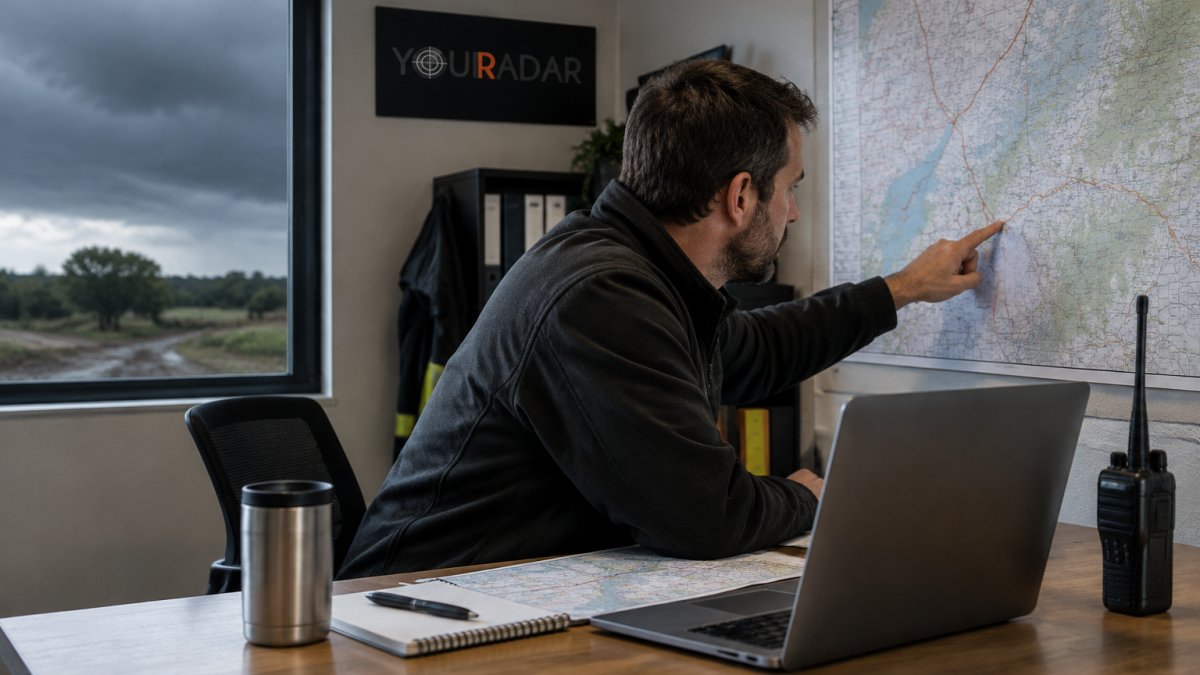
Build layers of location awareness:
- Last known position: record where each crew was before the network dropped.
- Planned route: note the roads each crew intended to take.
- Rally points: pre-agree safe meeting spots across your service area.
- Manual check-ins: crews report their location by voice or text.
Disaster mapping and simple paper backups still matter. A wall map with pins can do what a dead app cannot.
For practical methods on locating crews when GPS fails, see our guide on how to track field employee location.
A Disaster Response Checklist for Businesses with Crews on the Road
A disaster response checklist for businesses is a short, repeatable list that turns your plan into action under pressure. Print it, laminate it, and keep a copy in every truck and at the dispatch desk.
- Confirm every crew member’s status and location
- Decide stop-work or continue, and tell everyone
- Switch to backup communications
- Clear crews from high-risk sites first
- Log all check-ins and decisions
- Confirm fuel, supplies, and safe routes
- Set the next check-in time
- Notify customers with active jobs
Adapt ready-made safety lists into your own procedures. Our field service safety checklists guide gives you a starting point.
Fatigue, Mental Health, and Shift Rotation During the Acute Phase
The acute phase is the first stretch of a disaster, when everything is urgent and crews push hard. Fatigue and stress build fast, and tired crews make mistakes. Manage both on purpose, with a written rotation rather than a verbal “take a break when you need one.”
Shift Rotation and Rest Cycles
Build the rotation before the event, because you will not have time to design it mid-response. Build a written cap on continuous field hours and a minimum rest block before the event. Rotate crews through three states, active, standby, and rest, so standby crews can relieve active ones without a cold start.
- Rotate roles so no one carries the hardest tasks all day; move people between physical, driving, and coordination work.
- Enforce breaks and real sleep, not just a pause in the truck; a 20-minute nap is not a rest cycle.
- Pair up crews so no one works alone, especially on damage assessment and night work.
- Track hours on the same log as check-ins so the communications lead can flag anyone approaching the cap.
Watch out: skipping rest to “get ahead” during the acute phase is how small errors become injuries, the incident lead, not the crew lead, should own the decision to extend a shift, and it should be logged.
Psychological Support and Burnout Prevention
Disaster work carries a psychological load that ordinary field work does not: crews see damaged homes, distressed customers, and sometimes injury. Build support into the rotation rather than treating it as an afterthought.
- Brief before and debrief after each shift, a short check-in on what crews saw and how they are doing, not a performance review.
- Rotate people out of the highest-exposure tasks (body recovery, severely damaged structures) rather than leaving the same crew on them for the whole event.
- Name a point of contact for mental health support and share it on the same card as the communication plan, so crews know where to go without asking.
- Watch for warning signs, withdrawal, irritability, errors that did not happen before, and repeated missed check-ins, and treat them as a safety signal, not a discipline issue.
Measuring Fatigue Controls
You cannot manage what you do not measure. Track three indicators during the event and review them in the after-action debrief: maximum continuous hours worked per person, number of shifts that exceeded the cap, and number of safety incidents or near-misses logged during high-fatigue periods. These become the baseline for adjusting your rotation before the next event.
Getting Your Crews Back to Billable Work After the Storm
Recovery planning starts before the storm clears. The goal is to move from emergency response into stabilization and back to billable work without losing track of hours, jobs, or safety.
- Debrief fast. Capture what worked and what failed while it’s fresh.
- Reconcile records. Match timesheets and job logs to what actually happened.
- Reassign crews to safe, ready jobs first.
- Update the plan with lessons from the event.
Clean records matter here. Messy emergency hours turn into billing disputes and lost revenue. Accurate field reporting protects both your crews and your margins.
Put Your Emergency Plan on the Same Screen Your Crews Already Use
The best emergency plan is the one your crews will actually open. If it lives in a binder on a shelf, it won’t get used. Put it where your teams already work: on their phones.
YourRadar is a mobile-driven workforce management platform that offers dispatch mapping and automated timesheets to support field-to-office communication.
- Dispatch mapping supports workforce monitoring and location visibility.
- Automated timesheets streamline timesheet processing.
- A simple interface designed for non-tech-savvy employees.
If your team has resisted software before, our guide on getting field techs to use mobile apps shows how to drive real adoption.
A natural disaster will test your business whether you’re ready or not.
Frequently Asked Questions
How do you manage field teams during a natural disaster when phone networks are down?
Plan for at least two backup channels before the event. Satellite messengers, two-way radios, and a pre-agreed check-in schedule keep communication alive when cellular towers fail. Give every crew a paper contact sheet with the office number, a rally point, and a designated call-in time. Managing field teams during a disaster depends less on the technology and more on the routine: crews should know exactly who to contact, how, and by when, even if the answer is silence.
What should a field team emergency response plan include?
A workable plan names a response lead and a backup, lists every crew member with emergency contacts, sets evacuation triggers and rally points, and defines check-in intervals. Add a hazard identification section covering the specific risks your crews face, from flooding to downed power lines. Include mutual aid contacts, supplier backups, and a trigger for pausing work. Review it with the whole team twice a year and keep a printed copy in every vehicle.
How can dispatchers track and account for field employees during an emergency?
Field employee location tracking works best when it runs on the same app crews use for their daily jobs. Dispatch mapping supports location visibility for field crews. If the platform goes down, fall back to a phone tree with a roll-call deadline. The goal is a complete headcount within the first hour, with names, locations, and status logged so you can report to family, insurers, and emergency officials.
When should field crews stop work and evacuate?
Set the trigger before the season starts, not in the middle of a storm. Common triggers include an official evacuation order, sustained winds above your safety threshold, rising water on access roads, or a lightning strike within a set radius. Give supervisors authority to call a stop without waiting for the office. No job is worth a stranded crew, and customers understand a safety shutdown far better than a crew that pushes through.